


You might assume that making electronic music requires a sprawling desk full of expensive gear. The reality is that modern synthesis is often more powerful in a pocket-sized package than it was in a room-sized machine forty years ago.
If you are hunting for the Best Synthesizers for Beginners, you are actually in a prime position to start creating. Small units offer immediate feedback, which is exactly how you learn to shape sound quickly.
Key Takeaways
- Prioritize a hardware interface that gives you physical knobs for every major function so you avoid menu diving.
- Check if the unit includes a built-in sequencer, as this allows you to build complex patterns without needing a computer.
- Look for polyphony, or the ability to play multiple notes at once, if you intend to create chords instead of just single-note leads.
- Consider whether the device is battery-powered or requires a wall outlet, since portability dictates where you actually get to play.
- Confirm the presence of MIDI or USB ports so you can connect your hardware to other gear or recording software as you grow.
| Ultimate Compact Powerhouse |  |
Behringer PHARA-O Mini Synthesizer | Extremely portable design | Deep sound design capabilities | Intuitive knob layout | View on Amazon | Read Review |
| All In One Starter |  |
Akai MPK Mini Play MK3 | Includes built-in speaker | Responsive dynamic keybed | Portable standalone operation | View on Amazon | Read Review |
| Versatile Polyphonic Engine |  |
Arturia MiniFreak Hybrid Synthesizer | Powerful hybrid sound engine | Expressive aftertouch keys | Integrated 64-step sequencer | View on Amazon | Read Review |
| Vector Morphing Specialist |  |
Behringer Pro VS Mini Synthesizer | Unique vector morphing capabilities | Analog low-pass filter | Portable 5-voice architecture | View on Amazon | Read Review |
| Retro Fun Machine |  |
Stylophone Original Pocket Synth | Extremely simple to play | Iconic lo-fi sound | Battery operated portability | View on Amazon | Read Review |
| Advanced Sequence Control |  |
Akai MPK Mini Plus Controller | Extensive MIDI connectivity | Dedicated hardware sequencer | Comfortable 37-key layout | View on Amazon | Read Review |
| Experimental Sound Lab | 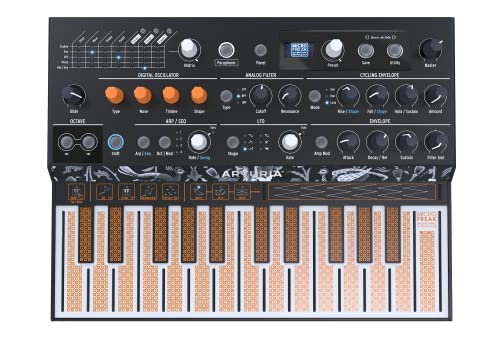 |
Arturia MicroFreak Digital Synth | Innovative wavetable oscillators | Polyphonic aftertouch support | Versatile analog filter | View on Amazon | Read Review |
| Streamlined Note Input |  |
Akai LPK25 MIDI Controller | Ultra-portable design | Responsive synth-action keys | Simple plug-and-play setup | View on Amazon | Read Review |
| Analog Texture Sculptor |  |
Korg Monotron Delay Synth | Authentic analog filter | Spacey delay effects | Highly portable size | View on Amazon | Read Review |
| Portable Polysynth Tweakability |  |
Roland AIRA Compact S-1 | True 4-voice polyphony | Unique D-Motion controls | Long battery life | View on Amazon | Read Review |
More Details on Our Top Picks
-
Behringer PHARA-O Mini Synthesizer
If you want to pack serious sound design potential into a tiny footprint, this is your best bet. It functions like a pocket-sized laboratory for synthesis, offering enough depth to keep you busy for hours while remaining simple enough for a quick session on the couch.
But keep in mind that the small interface requires a bit of patience. You will need to spend time with the manual to master the routing, but the resulting textures are worth the effort.
- Brand Name:Behringer
- Product Type:Mini Synthesizer
- Additional Feature:Compact form factor
- Additional Feature:Robust sound engine
- Additional Feature:Intuitive control surface
-
Akai MPK Mini Play MK3
This unit is a fantastic starting point because it includes a built-in speaker and internal sounds. You do not need a computer to start making music, which removes the technical friction often associated with learning synthesis.
The dynamic keybed feels surprisingly responsive for its size. Just remember that it is primarily a controller, so the internal sounds are meant for quick inspiration rather than complex studio production.
- Brand Name:Akai Professional
- Product Type:MIDI Keyboard Controller
- Key Count:25
- Power Source:Battery or USB
- Connection Type:USB and MIDI
- Additional Feature:MPC pads for percussion
- Additional Feature:Integrated sound library
- Additional Feature:Compact mobile design
-
Arturia MiniFreak Hybrid Synthesizer
Think of this as a sonic playground for those who enjoy exploring both digital and analog characteristics. With its six-voice polyphonic engine, you can create rich chords and complex textures that sound professional right out of the box.
The inclusion of aftertouch keys adds a layer of expressiveness that is rare at this level. You might find the menu diving a bit deep, but the layout remains clear enough to navigate without getting lost.
- Brand Name:Arturia
- Product Type:Hybrid Synthesizer
- Key Count:37
- Voice Count:6
- Power Source:Power adapter
- Connection Type:USB, MIDI, CV
- Additional Feature:Advanced modulation matrix
- Additional Feature:Three digital effects engines
- Additional Feature:Polyphonic step sequencer
-
Behringer Pro VS Mini Synthesizer
If you are fascinated by vector synthesis, this little box is an absolute delight. It uses four oscillators per voice to create shifting, evolving sounds that feel alive and constantly changing.
The analog low-pass filter adds a smooth warmth to the digital oscillators. It is a specialized tool, so it works better as a companion to your setup rather than a primary workstation.
- Brand Name:Behringer
- Product Type:Hybrid Synthesizer
- Voice Count:5
- Power Source:USB
- Connection Type:USB, MIDI
- Additional Feature:16-step sequencer included
- Additional Feature:Built-in arpeggiator
- Additional Feature:Four oscillators per voice
-
Stylophone Original Pocket Synth
This is the most straightforward instrument in the group, offering a nostalgic sound that is iconic in its own right. It is essentially a stylus-operated keyboard that provides a unique, buzzy tone perfect for lo-fi experimentation.
You should view this as a creative toy rather than a professional studio piece. Its simplicity is its strength, making it an excellent choice for anyone who wants to make noise without reading a manual.
- Brand Name:Stylophone
- Product Type:Pocket Synthesizer
- Power Source:Battery
- Additional Feature:Stylus-based interface
- Additional Feature:Vibrato control switch
- Additional Feature:Built-in speaker
-
Akai MPK Mini Plus Controller
This controller is a step up for those who want to integrate hardware into their existing setup. It features dedicated CV and gate outputs, which allow you to control modular gear or older synthesizers with ease.
The 37-key layout gives you more room to breathe than the standard 25-key versions. It is a reliable piece of gear for anyone ready to take full command of a studio environment.
- Brand Name:Akai Professional
- Product Type:MIDI Keyboard Controller
- Key Count:37
- Power Source:USB
- Connection Type:USB, MIDI, CV/Gate
- Additional Feature:8 MPC style pads
- Additional Feature:Transport controls
- Additional Feature:Chord and scale modes
-
Arturia MicroFreak Digital Synth
This synth is for the curious sound designer who wants to push boundaries. Its digital wavetable engine offers a massive variety of sounds, while the analog filter keeps the output grounded and musical.
The PCB-style touch keyboard is a different experience from traditional keys. It supports polyphonic aftertouch, which lets you manipulate your sound in ways that standard keyboards cannot replicate.
- Brand Name:Arturia
- Product Type:Hybrid Synthesizer
- Key Count:25
- Power Source:USB/Power adapter
- Connection Type:USB, MIDI, CV
- Additional Feature:Capacitive touch interface
- Additional Feature:Modulation matrix
- Additional Feature:Multi-mode digital oscillators
-
Akai LPK25 MIDI Controller
Sometimes you just need a no-nonsense keyboard to play melodies into your computer. This controller is stripped of all extra buttons and pads, focusing entirely on providing a solid playing experience.
It fits easily into a backpack alongside a laptop. While it lacks internal sounds, it is the perfect companion for someone who already owns a software-based studio.
- Brand Name:Akai Professional
- Product Type:MIDI Keyboard Controller
- Key Count:25
- Power Source:USB
- Connection Type:USB
- Additional Feature:Built-in arpeggiator
- Additional Feature:Sustain pedal input
- Additional Feature:Octave range buttons
-
Korg Monotron Delay Synth
If you want to add gritty analog character to your sound, look no further. This device is famous for its spacey delay effects that can turn simple signals into chaotic, otherworldly soundscapes.
The ribbon controller is not designed for traditional piano playing, but it is excellent for slides and experimental leads. It is a wild tool for anyone who loves turning knobs until things get weird.
- Brand Name:Korg
- Product Type:Analog Synthesizer
- Power Source:Battery
- Connection Type:1/8 inch jack
- Additional Feature:Ribbon touch keyboard
- Additional Feature:External audio input
- Additional Feature:Internal speaker
-
Roland AIRA Compact S-1
This unit packs a stunning amount of power into a tiny, battery-powered shell. It is a true polysynth that excels at creating classic, punchy tones with a modern digital twist.
The D-Motion control lets you manipulate sounds just by moving the device itself. It is a fantastic choice for performers who want to add physical movement to their sound design.
- Brand Name:Roland
- Product Type:Polyphonic Synthesizer
- Voice Count:4
- Power Source:Battery
- Connection Type:USB-C
- Additional Feature:64-step sequencer
- Additional Feature:Waveform drawing tools
- Additional Feature:Compact, durable build
Frequently Asked Questions
Do I need to know how to play piano to use a synthesizer?
You do not need formal training to start making music. While piano skills help, synthesizers are often more about sound design and texture than traditional technique. You can create massive soundscapes by simply holding down a single note and adjusting knobs.
What is a patch?
A patch is simply a saved sound setting stored in the memory of the synthesizer. Think of it like a recipe for a specific tone, including the filter settings and envelope shapes. Most modern synths come with hundreds of factory presets so you have plenty of sounds to play with immediately.
Will I need to buy extra speakers?
Many synthesizers do not have built-in speakers, so you will likely need a pair of studio headphones or external powered speakers. Check the specifications of the specific model to see if it includes an internal amp. Most musicians prefer using high-quality headphones to keep their monitoring experience clear and consistent.
What is an oscillator?
The oscillator is the sound source inside the synthesizer. It generates the raw waveform, such as a sine, square, or sawtooth wave. You can think of the oscillator as the engine of a car, providing the fundamental power that you then shape using filters and effects.
Can I record my synthesizer into a computer?
You certainly can, provided you have an audio interface. This device acts as a bridge, turning the electrical signal from your synth into digital data for your computer. Once connected, you can record your performances directly into a digital audio workstation to edit and polish your tracks.