


Many people think you need a room full of expensive, wall-to-wall hardware to create professional music. That is simply not true. You can start building your signature sound today with equipment that fits comfortably on a modest desk.
Finding the Best Beginner Synthesizers requires ignoring the hype and focusing on what actually helps you learn. This list breaks down the essentials for your home setup. Let's see what works for your specific creative flow.
Key Takeaways
- Prioritize models that offer a dedicated arpeggiator to help you learn rhythm and melodic structure quickly.
- Check if your device features built-in speakers because portability is crucial when you want to capture ideas away from a desk.
- Ensure the keys or interface provide enough tactile feedback to help you develop proper playing technique.
- Look for hardware that includes MIDI connectivity so you can grow your setup alongside your favorite music software.
- Focus on devices with a high number of presets, as these provide a solid starting point for understanding sound design basics.
| Ultimate All-In-One Starter |  |
Akai MPK Mini Play MK3 | Portable internal sound engine | Responsive dynamic keybed | Iconic MPC drum pads | View on Amazon | Read Review |
| Minimalist Desktop Companion |  |
Akai LPK25 MIDI Keyboard | Extremely compact footprint | Simple plug-and-play setup | Responsive synth-action keys | View on Amazon | Read Review |
| Compact Sound Sculptor |  |
Behringer PHARA-O Mini Synthesizer | Highly portable design | Excellent for sound design | Intuitive control layout | View on Amazon | Read Review |
| Deep Hybrid Powerhouse |  |
Arturia MiniFreak Hybrid Synthesizer | Versatile hybrid engine | Expressive aftertouch keys | Integrated digital effects | View on Amazon | Read Review |
| Retro Fun Machine |  |
Stylophone Original Pocket Synth | Iconic retro aesthetic | Unique stylus interface | Very affordable entry | View on Amazon | Read Review |
| Experimental Sonic Explorer | 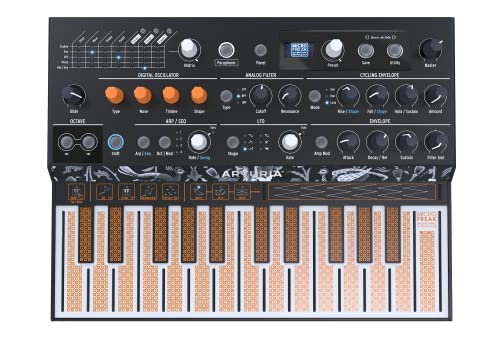 |
Arturia MicroFreak Digital Synthesizer | Diverse oscillator types | Unique touch-sensitive keys | Analog filter integration | View on Amazon | Read Review |
| Standard Production Workhorse |  |
Akai MPK Mini MK3 | Seamless software integration | Excellent velocity-sensitive pads | Compact desktop size | View on Amazon | Read Review |
| Vocoder Performance Specialist |  |
Novation MiniNova Analog Modeling | High voice count | Powerful onboard vocoder | Versatile animate buttons | View on Amazon | Read Review |
| Gritty Analog Texture |  |
Stylophone GENX-2 Analogue Synth | Genuine analog circuitry | Patchable CV outputs | Built-in analog delay | View on Amazon | Read Review |
| Vector Synthesis Marvel |  |
Behringer Pro VS Mini | Complex vector morphing | Portable hybrid design | Integrated arpeggiator | View on Amazon | Read Review |
More Details on Our Top Picks
-
Akai MPK Mini Play MK3
If you want to start making music without needing a computer immediately, this is your best bet. It packs a built-in speaker and a library of internal sounds directly into the controller, meaning you can play right out of the box.
The dynamic keybed feels responsive enough to capture your nuances, and the MPC pads are perfect for rhythm work. Just keep in mind that the speakers are compact, so they won't replace a dedicated studio monitor setup for professional mixing.
- Brand Name:Akai Professional
- Keyboard Size:25 keys
- Connectivity Type:USB MIDI
- Power Source:Battery or USB
- Included Software:MPC Beats suite
- Additional Feature:Built-in speaker for standalone play
- Additional Feature:Eight velocity-sensitive drum pads
- Additional Feature:Assignable control knobs
-
Akai LPK25 MIDI Keyboard
Sometimes you just need a simple tool to get notes into your DAW. This controller strips away the extra bells and whistles, leaving you with a clean, compact 25-key layout that fits on the most cluttered desk.
It serves as a reliable bridge between your fingers and your software. Because it lacks onboard sounds, it is strictly a controller for your computer, which might disappoint those looking for a standalone instrument.
- Brand Name:Akai Professional
- Keyboard Size:25 keys
- Connectivity Type:USB MIDI
- Additional Feature:Built-in arpeggiator
- Additional Feature:Sustain pedal input
- Additional Feature:Four memory banks for presets
-
Behringer PHARA-O Mini Synthesizer
This little unit focuses on those who want to experiment with raw sound design in a tiny form factor. It acts like a compact laboratory for people eager to learn how oscillators and filters affect a signal.
Its size makes it an excellent addition to a travel rig. Since it lacks a traditional keyboard, you will need to get comfortable with its specific interface for trigger inputs.
- Brand Name:Behringer
- Additional Feature:Compact analog architecture
- Additional Feature:Precision filter controls
- Additional Feature:Desktop-friendly form factor
-
Arturia MiniFreak Hybrid Synthesizer
This is the machine for someone who wants to explore complex soundscapes without the frustration of a steep learning curve. It uses two digital engines paired with an analog filter, offering a sonic range that rivals much larger systems.
The 37 keys include polyphonic aftertouch, which adds a professional level of expression to your performances. It is a dense instrument, so prepare to spend some time reading the manual to master the modulation matrix.
- Brand Name:Arturia
- Keyboard Size:37 keys
- Voice Count:6 voices
- Additional Feature:64-step polyphonic sequencer
- Additional Feature:Customizable modulation matrix
- Additional Feature:Analog filter architecture
-
Stylophone Original Pocket Synth
If you want something that feels more like a toy but functions as a genuine electronic instrument, you have found it. You play it with a stylus pen, which creates a unique, wobbly pitch-bend effect that is impossible to replicate on standard keys.
It is a fantastic tool for adding quirky, lo-fi textures to your tracks. Don't expect high-fidelity precision, as the pitch can fluctuate depending on your touch.
- Brand Name:Stylophone
- Power Source:Battery
- Additional Feature:Built-in speaker
- Additional Feature:Vibrato switch
- Additional Feature:Headphone output
-
Arturia MicroFreak Digital Synthesizer
This synth is a playground for those who love to tinker with digital oscillators. It features a capacitive touch keyboard that feels quite different from traditional spring-loaded keys, but it offers a flat, sleek surface that invites experimentation.
The multi-mode oscillators allow for a vast array of sounds, from harsh textures to smooth pads. Keep in mind that the touch keys require a specific playing style to trigger accurately.
- Brand Name:Arturia
- Keyboard Size:25 keys
- Additional Feature:Polyphonic aftertouch
- Additional Feature:Modulation matrix
- Additional Feature:Sequence randomization
-
Akai MPK Mini MK3
This is the workhorse of the bedroom producer world. With its eight backlit pads and eight assignable knobs, it gives you tactile control over your virtual instruments and mixing faders.
It is designed to map automatically to major production software, saving you hours of configuration time. It is strictly a MIDI controller, so you must have a computer running to hear any sound.
- Brand Name:Akai Professional
- Keyboard Size:25 keys
- Connectivity Type:USB MIDI
- Included Software:MPC Beats, Sound packs
- Additional Feature:4-way thumbstick for pitch
- Additional Feature:Arpeggiator with adjustable resolution
- Additional Feature:Dedicated note repeat function
-
Novation MiniNova Analog Modeling
If you want to mangle your vocals while playing thick synth leads, this is a top choice. The built-in vocoder is surprisingly expressive, turning simple voice signals into robotic or melodic textures with ease.
It offers 18 voices of polyphony, which is plenty for complex chord work. The menu system can get a bit deep, so you will need to keep the preset list handy while you learn the workflow.
- Brand Name:Novation
- Keyboard Size:37 mini keys
- Voice Count:18 voices
- Additional Feature:Five effects per voice
- Additional Feature:256 factory presets
- Additional Feature:USB connectivity
-
Stylophone GENX-2 Analogue Synth
This model takes the concept of the original and adds serious analog circuitry. With an LFO and filter, you can actually shape your sounds rather than just triggering preset tones.
The addition of a CV gate output means you can connect it to other modular gear as you grow your collection. It retains the stylus interface, which remains a polarizing but charming way to interact with the signal.
- Brand Name:Stylophone
- Power Source:Battery
- Additional Feature:Adjustable LFO speed
- Additional Feature:Low-pass filter
- Additional Feature:Integrated speaker
-
Behringer Pro VS Mini
This synth brings the classic vector synthesis style to a modern, portable format. By morphing between four oscillators per voice, you can create evolving, atmospheric sounds that are difficult to achieve on standard synths.
The 16-step sequencer is perfect for building quick, hypnotic loops on the move. Given its small size, the screen is limited in how much information it can display at once.
- Brand Name:Behringer
- Voice Count:5 voices
- Additional Feature:Analog low-pass filter
- Additional Feature:16-step sequencer
- Additional Feature:Vector joystick control
Frequently Asked Questions
Do I need to know how to play piano to use a synthesizer?
You do not need formal piano training to start making music. Synthesizers allow you to create textures and soundscapes that do not require complex chords or traditional technique. Learning basic music theory will help you grow, but the focus is often on sonic exploration rather than technical proficiency.
What is the difference between a synthesizer and a MIDI controller?
A synthesizer generates its own sound, meaning you can plug it into speakers and play immediately. A MIDI controller has keys but no internal sound engine, so it only sends data to your computer to trigger software instruments. You need a computer running music production software to hear any sound from a controller.
Can I record my synthesizer directly into my computer?
You can record your synth by connecting its audio output to an audio interface plugged into your computer. Some modern synthesizers also feature USB audio functionality, allowing them to send sound directly to your recording software via a single cable. This simplifies your setup and helps you capture ideas quickly.
Should I buy a monophonic or polyphonic synthesizer first?
If you want to play chords or pads, you should definitely choose a polyphonic synth. Monophonic instruments are powerful for crafting punchy bass lines and piercing lead melodies. Most beginners benefit from the flexibility of a polyphonic unit because it covers a wider range of musical styles.
Do synthesizers require a lot of maintenance?
Most modern synthesizers are solid-state devices that require very little upkeep. Keep your instrument in a dust-free environment and avoid spilling liquids near the knobs or keys. If you choose an older analog model, you might need to occasionally calibrate the oscillators to keep them in tune.