

Splinters are a gardener's worst nightmare, and the grey, weathered fuzz on your deck boards is basically a flashing neon sign that says maintenance is overdue. Nothing restores a deck faster than stripping away that dead wood to reveal the fresh grain hidden underneath.
Getting the right tools is the difference between a relaxing weekend and a backache that lasts until Tuesday. Picking the Best Sanders for Sanding a Deck requires thinking about surface area and reach. Keep reading to see which tools handle these tight corners and open spaces best.
Key Takeaways
- Prioritize a random orbital sander for large, flat deck surfaces to prevent leaving visible swirl marks in the wood.
- Use a detail sander with a pointed pad specifically for tight corners where your main sander cannot reach.
- Check that your sander has an effective dust collection system, such as a micro-filter box, to keep sawdust out of your eyes.
- Match your sandpaper grit to the condition of the wood: 60-80 grit for rough stripping and 120-150 grit for smoothing.
- Ensure your power cord is long enough to cover your workspace or keep an extension cord handy for mobility.
| Ultimate Detail Variety |  |
Black and Decker Detail Sanding Pads | Wide grit range | Easy attachment | Fifty-five count pack | View on Amazon | Read Review |
| Compact Corner Specialist |  |
Black and Decker 1.2 Amp Detail Sander | Lightweight and compact | Ergonomic grip options | Integrated dust collector | View on Amazon | Read Review |
| Budget Refill Essential |  |
Coceca Mouse Detail Sandpaper Assortment | Generous quantity included | Versatile grit variety | Compatible with mouse sanders | View on Amazon | Read Review |
| Versatile Surface Optimizer | 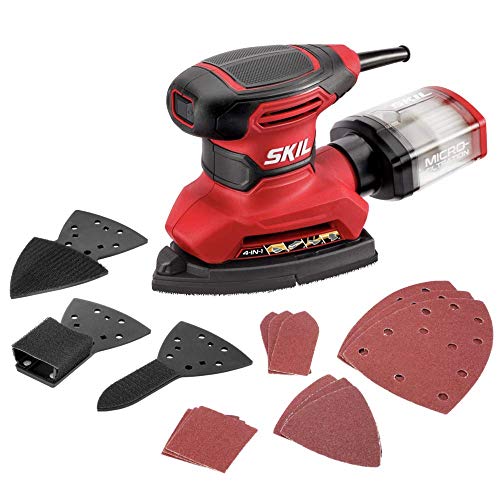 |
Skil Multi-Function Detail Sander | Three unique attachments | Clean dust filtration | Multiple sanding surfaces | View on Amazon | Read Review |
| Flat Surface Powerhouse |  |
Skil 5-Inch Random Orbital Sander | Efficient surface coverage | Smooth finish quality | Strong dust collection | View on Amazon | Read Review |
More Details on Our Top Picks
-
Black and Decker Detail Sanding Pads
If you are finishing a deck with intricate railings or tight corners, these replacement sanding sheets are your best companions. They cover a wide spectrum of grit levels, allowing you to move from aggressive material removal with 60 grit to a smooth finish with 220 grit.
Because these pads use a hook and loop system, you can switch between sheets in seconds without fussing with adhesive. Just keep in mind that these are specifically designed for the mouse-shaped base, so they will not work on standard orbital sanders.
- Brand:Black and Decker
- Tool Type:Sanding sheets
- Kit Contents:55 sanding pads
- Key Specs:12 hole configuration
- Additional Feature:Hook and loop backing
- Additional Feature:Five distinct grit levels
- Additional Feature:Tailored for mouse sanders
-
Black and Decker 1.2 Amp Detail Sander
This tool functions like a precise scalpel for your deck, reaching into spots that larger sanders simply cannot touch. Its 1.2 amp motor delivers enough power to clean up weathered wood on spindles or decorative trim, while the compact frame keeps your arm from tiring out during long sessions.
The three-position grip provides a steady hand, which is vital when you need to maintain control on uneven surfaces. While it is perfect for detail work, do not expect it to handle wide, flat deck boards quickly, as the base is sized for smaller tasks.
- Brand:Black and Decker
- Tool Type:Detail sander
- Power Source:Corded
- Dust Management:Dust collector included
- Key Specs:16,000 OPM
- Additional Feature:Comfortable three position grip
- Additional Feature:Compact design for corners
- Additional Feature:Simple power switch
-
Coceca Mouse Detail Sandpaper Assortment
Think of these as the workhorse supplies for your deck maintenance kit. You get a massive assortment of pads that fit standard mouse sanders, making them ideal for someone who has a lot of surface area to clean up before applying a new coat of stain.
These sheets are durable enough to survive the rough texture of cedar or pine without tearing prematurely. You should note that the variety is excellent for general sanding, but you might find yourself needing more of the coarsest grit if your deck boards are heavily damaged.
- Brand:Coceca
- Tool Type:Sanding sheets
- Kit Contents:50 sanding pads
- Key Specs:40 to 240 grit
- Additional Feature:Assorted grit levels
- Additional Feature:Standard mouse shape
- Additional Feature:Durable paper construction
-
Skil Multi-Function Detail Sander
This sander is a bit of a utility player, bringing three different attachments to the table. It is perfect if your deck has a mix of flat edges and odd angles, as you can swap the pad shapes to match the specific geometry of your wood trim.
The micro-filter dust box keeps your workspace much cleaner than older models that rely on simple bags. Just be aware that the multiple attachments mean you have more pieces to keep track of in your garage, so find a safe spot for them when you finish the job.
- Brand:Skil
- Tool Type:Detail sander
- Power Source:Corded
- Dust Management:Micro-filter dust box
- Kit Contents:12 sanding sheets
- Additional Feature:Multi-function base shape
- Additional Feature:Efficient dust collection system
- Additional Feature:Quick-change attachment design
-
Skil 5-Inch Random Orbital Sander
When you have large, open sections of decking to prepare, this random orbital sander acts like a heavy-duty broom for your wood. The five-inch circular pad covers ground quickly, and the random motion prevents those pesky swirl marks that can ruin the look of your stain.
The cyclonic dust box is a welcome feature, as it traps fine sawdust effectively before it spreads across your patio. Since this unit is built for flat boards, do not attempt to use it on intricate railing or tight corners where it simply will not fit.
- Brand:Skil
- Tool Type:Random orbital sander
- Power Source:Corded
- Dust Management:Cyclonic dust box
- Kit Contents:3 sanding sheets
- Key Specs:5 inch pad
- Additional Feature:Random motion for smoothness
- Additional Feature:High volume dust collection
- Additional Feature:Fast material removal
Frequently Asked Questions
Do I really need to sand my deck before applying a new stain?
Yes, you do. Sanding removes the dead, gray wood fibers and opens up the pores of the timber, which allows the new stain to penetrate deeply. If you skip this step, the finish will likely peel or flake off after just one winter. Think of sanding as a way to create a blank canvas for your wood treatment.
What grit of sandpaper should I start with?
Start with a 60 or 80 grit paper to remove old finish and smooth out any splintered areas. You can follow that up with a 100 or 120 grit paper for a smoother finish before you apply your stain. Avoid going higher than 150 grit on decking. If you sand the wood too smooth, you might actually close off the pores, which prevents the stain from soaking in properly.
Can I use a palm sander for the entire deck?
You can, but your back might not thank you for it. A palm sander is small and lightweight, which makes it perfect for tight corners or vertical railings. For the main floorboards, a larger random orbital sander with a 5-inch or 6-inch pad will save you hours of labor. Use the palm sander for the detail work and the orbital sander for the open spaces.
How often should I change the sandpaper pads?
Change your pad the moment it stops removing material effectively or starts to look clogged with old stain. A dull sheet will cause you to push down too hard, which leads to uneven sanding and burns the wood surface. As a general rule, replace the pad once you see the grit wearing off or when the paper starts to feel smooth to the touch. Frequent changes will actually speed up your work in the long run.
Is there a way to sand between the deck boards?
Most power sanders will not fit between standard deck gaps. You will need to use a hand sanding block or a dedicated edge tool to reach those narrow spots. Some people prefer to use a stiff wire brush to clean out the gaps before they start power sanding the main surfaces. This keeps the debris from getting trapped and ensures a uniform look across the entire deck.